Herb&Lust
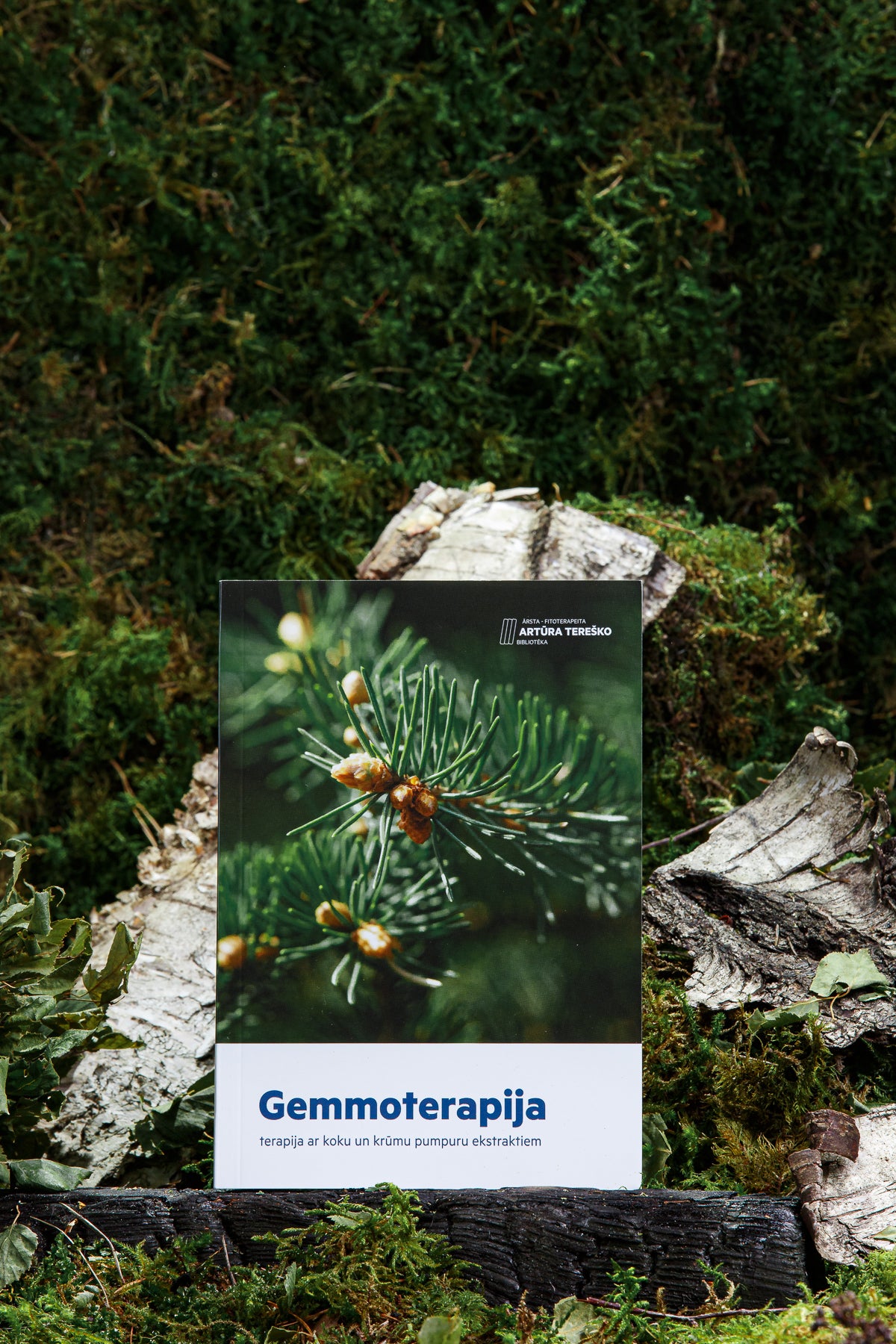
Book "Gemmotherapy"
Book "Gemmotherapy"
Couldn't load pickup availability
After reading several books on gemmotherapy and familiarizing myself with scientific research, I am convinced that the use of gemmotherapy extracts is simple, harmless, provides stable health improvements, is relatively inexpensive, and moreover, these preparations can be made by anyone, if they have the desire, time, knowledge, and an inclination towards natural therapy.
Gemmotherapy is not aimed at suppressing acute symptoms; it aims to stimulate the body's self-regulatory powers. Gemmotherapy affects the adrenal glands, stabilizing immune reactions; the lymphatic and circulatory systems, promoting cell nourishment and cleansing; and the intestines and kidneys, promoting the body's cleansing from metabolic end-products.
I have decided to prepare gemmotherapy preparations and introduce readers to this new, potentially very significant direction in phytotherapy, which can be considered a bridge between phytotherapy and homeopathy.
I have safely tried these preparations on myself. It seems I have become very active, work a lot, don't get tired, and tolerate heat and cold well. I lost four kilograms, which I don't regret at all. I am no longer as forgetful as half a year ago, I remember what I've promised more often, although I still need to work on that.
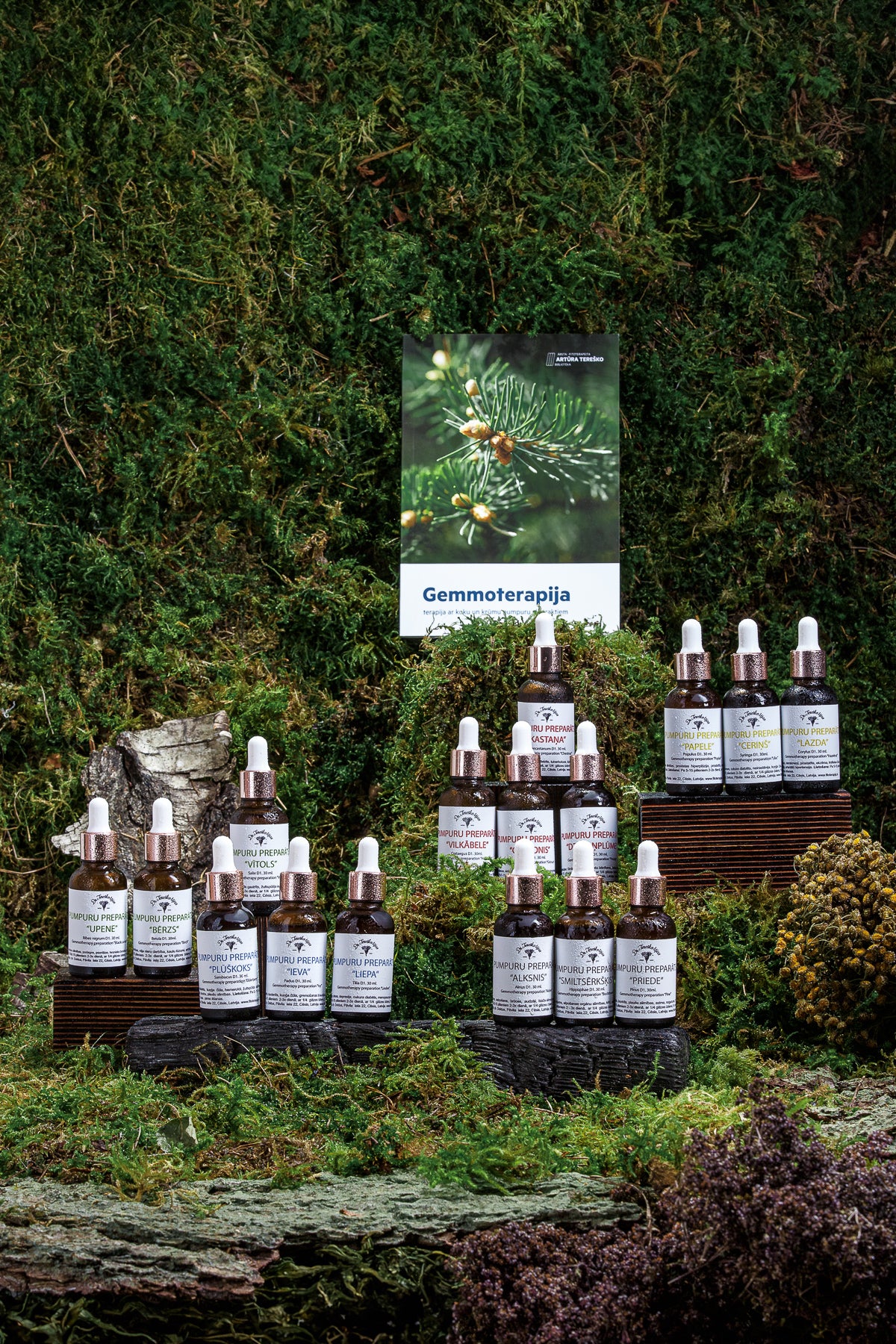
The idea of gemmotherapy came from my daughter Ilze, who is an excellent homeopath and family doctor. Once she asked me: "How about it, Dad, if you made tinctures from the buds of various trees?" This was followed by research into this area on the internet, ordering books to understand what it is, and collecting spring buds from 15 different species of trees and shrubs, followed by the preparation of 15 types of gemmotherapy extracts according to all pharmacopoeia laws.
Gemmotherapy preparations are intended for the treatment of both acute and chronic diseases.
I hope that the information provided in this brochure and the use of gemmotherapy will help you overcome minor health problems. However, if, in acute cases, using these preparations, the illness does not subside within 24 hours, you should consult a doctor to understand what has happened.
The term 'gemmotherapy' comes from the Latin word gemma, which, not without reason, has two meanings - "precious stone" or "bud," and from the Greek therapein - treatment. Thus, it is treatment with plant bud preparations. However, modern gemmotherapy also uses other parts of the plant that contain meristematic tissues - sprouts, shoots, and young root growths. In turn, meristematic tissues in plants are the same as stem cells in humans. In plants, leaves, branches, flowers, and seeds develop from meristematic tissues, while in humans, all possible cells that sustain human life develop from stem cells.
The use of plant buds for medicinal purposes has been known since ancient times.
The very idea of using embryonic parts of plants for medicinal purposes is not new – recommendations for using buds, shoots, and sprouts can be found in the works of Avicenna, Hippocrates, Galen, in Chinese folk medicine, Ayurvedic medicine, and Homeopathy, where the entire plant, including roots, is used to prepare Mother Tincture. Given that gemmotherapy uses not only buds but also plant root shoots, these gemmotherapy preparations could be considered homeopathic preparations and be very useful in homeopathic practice.
The famous Renaissance physician Paracelsus had amazing intuition, writing about the existence of various forces in sprouts, buds, and unripe fruits. He believed that attention should be paid to the entire plant, especially the buds, considering that buds contain everything found in the adult plant.
In the European Union, gemmotherapy has been approved as an auxiliary medical method, thanks to which gemmotherapy has gained significant popularity among homeopaths and naturopaths in Australia, Belgium, Canada, France, Germany, Italy, New Zealand, and Romania.
It can be said that the popularity of gemmotherapy in the world is constantly growing, with new research being conducted; gemmotherapy specialists are also accumulating knowledge and discovering new possibilities for the application of these preparations. It is believed that this botanical therapy has enormous potential for acute and chronic symptoms.
I believe that gemmotherapy's gentle yet powerful effect, as well as its ease of use and accessibility, will be appreciated in an era when increasingly toxic treatments are being used in medical practice.
It has been found that gemmotherapy can also be used in pediatric treatment and for geriatric patients. Most extracts are also safe during pregnancy. It has been proven that bud therapy provides immediate effect in acute cases, but long-term treatment is necessary for chronic diseases.
Gemmotherapy restores the natural functions of organs, reducing or eliminating the need to supplement with artificial vitamins and minerals that the body produces naturally.
Applying gemmotherapy in practice has confirmed that its action extends to the organic and cellular level.
The best results were obtained by using a mixture of 55% ethyl alcohol and food-grade glycerin for bud extraction.
The biologically active substances contained in buds ensure the biological activity of organ tissues, primarily by stimulating the excretory function of the kidneys and liver and the protective functions of the lymphatic system.
According to observations by doctors practicing gemmotherapy, people treated with gemmotherapy showed normalization of blood serum protein fraction levels, which is one of the most important health criteria.
The Power Source of Buds
The power source of buds is meristematic (from Greek meristós – divisible) tissues, which hold the potential to divide and form new cells and plant parts. The meristematic cells of a bud or other vegetative element "sleep" until favorable climatic conditions develop, and, upon their arrival, the cells divide, ensuring continuous growth of the plant mass. Meristematic cells from one bud gradually differentiate, forming various plant elements – flowers, branches, leaves, roots. Apical meristems are distinguished, located at the ends of roots or shoots and determining the growth of these organs in length; cambial meristems, which ensure the growth of roots and stems in thickness and girth. There are also wound healing meristems, which form at sites of tissue and organ damage and are involved in healing the damage by exuding resins, sticky substances, and forming scar tissue.
The biological compounds found in buds are highly activated, so they can actively function not only in the plant but also in the human body. Plants and humans are united. For the most part, all trace elements and vitamins that are in a plant are also found in humans. The Almighty power in nature has established such an order that plants serve humans and animals as food for maintaining health and as medicine for treating diseases, as well as for furnishing and warming homes. Humans and animals, in turn, wittingly or unwittingly, serve plants by multiplying them, for which plants are grateful to all.
All bud tissue cells have the ability to transform into various vegetative forms of the plant. The founder of gemmotherapy, Pol Henry, in his works, figuratively called this process endless embryogenesis. In the animal kingdom, there are no meristematic tissues, but there are stem cells that ensure embryonic growth and development, and in an adult organism, if necessary, they can differentiate into any cell of the organism. Meristematic cells are characterized by high metabolic activity. Thus, in gemmotherapy, "embryonic" plant tissues that contain reproductive activity are used for therapeutic purposes, in contrast to classical phytotherapy, which uses mature plant tissues that have lost the ability to transform.
Active substances in buds that ensure the effectiveness of gemmo-preparations
In addition to containing vitamins, trace elements, and minerals, buds and young shoots, compared to other plant parts, have more nucleic acids and growth hormones. They also contain very specific substances, such as auxins and gibberellins, which begin to disappear after the plant greens.
Thus, the most significant group of substances in buds that ensures the effectiveness of gemmotherapy are growth phytohormones, such as auxin, gibberellin, and cytokinins.
Auxins (from Greek: auxein – to grow, to increase) are a group of chemical compounds that perform regulatory functions in plants – growth, flowering, fruit ripening. Unlike other growth regulators, auxins, together with cytokinins, albeit in small amounts, are necessary for almost all physiological processes in any plant.
In plants, auxin synthesis primarily occurs in new tissues where the most intensive cell division takes place. Basically, the amino acid tryptophan is used as a raw material, which is also present in the human body and, as an essential amino acid, plays the role of a raw material for the happiness hormone serotonin.
The mentioned cytokinins are specific plant regulatory chemical compounds, or phytohormones, which are synthesized in the growing tips of plant roots and then transported through the vessels to above-ground organs, where they ensure cytokinesis – stimulating cell division and inducing shoot differentiation, activating leaf growth, stimulating chloroplast formation, delaying leaf senescence, participating in nitrogen metabolism.
Cytokinins in plants slow down the aging process by inhibiting the breakdown of certain proteins, stimulating protein and RNA synthesis, and mobilizing nutrients from surrounding tissues. Cytokinins also slow down the wilting of leaves, which is why florists widely use them by spraying cut flowers with a cytokinin solution to keep them fresh longer.
Cytokinins do not have a specific effect on the human body; they only play a role in auxin formation.
Gibberellin is synthesized in almost all plant organs, especially in terminal leaf buds and root tips. Chemically, it is an isoprene-based terpenoid. Gibberellin stimulates cell division, activates stem growth, flowering, tuber and plant seed germination.
In the human body, this terpenoid acts as a powerful antioxidant.
The following components have also been found in tree and shrub buds, which are also of great importance for improving and maintaining human health:
• resins,
• essential oil,
• tannic acids, tannins,
• chlorophyll,
• cinnamic acid,
• vitamins,
• saponins,
• minerals and trace elements,
• flavonoids.
However, biologically active substances alone cannot explain such a versatile and powerful effect of buds on the human body. Scientists suggest that this method has an energetic effect. Representatives of classical medicine fear mentioning energy in medicine and human healing "like the devil fears holy water," but this happens out of ignorance.
The latest scientific discoveries indicate that atoms, from which all matter is composed, are made up of quanta, which have no measurable mass but have measurable energy. Thus, the fundamental cornerstone of the entire world is not mass, but energy. From this position, one can explain the good influence of healers, homeopathy, and gemmotherapy on human health, diagnosis based on the human aura, as well as the appearance of ghosts and the poltergeist phenomenon.
Possibilities of Gemmotherapy:
• Strengthening the body's defenses (immunity).
• Cleansing the body of harmful substances – pesticides, herbicides, amalgam lead compounds, food E-numbers.
• Eliminating the consequences of stress caused by negative experiences.
• Preventing depression.
• Neutralizing the causative agent of illness.
• Reducing symptoms of illness.
• Regulating metabolic processes.
• Providing the body with necessary nutrients, vitamins, and trace elements.
Buds have an antibacterial, immune-boosting, wound-healing, invigorating, and cleansing effect on the human body. When the "rejuvenating" components of plants enter the human body, they can stimulate cell life and renew it, supporting healing processes by activating stem cells.
The effect of buds is comparable to the sum of the medicinal effects of all other plant parts: roots, stems, leaves, flowers.
For specific recommendations on improving health, see further in the book: "Gemmotherapy – Therapy with Tree and Shrub Bud Extracts."